 |
| Just another day on the cutting edge of scientific research |
Tuesday, 12 June 2012
Typical Quiet Day in the Paulsen lab
Here's a photo of a typical day in the Paulsen lab. The large number of people wearing lab coats and looking busy? Thats normal. It's just a coincidence that the vice chancellor was coming through the labs for a tour.

Wednesday, 6 June 2012
Membrane Transport Protein Humour
One of my research interests for my entire career has been membrane transporter proteins, particularly multidrug efflux pumps that make bacteria resistant by pumping antibiotics out of the cell. After 20 or so years researching membrane transport proteins, I can honestly say this is the first membrane transport protein humour I've seen.
 |
| The Best Way to Break Through a Cell Wall |
Thursday, 31 May 2012
Dance Dance DNA
Often as part of research grant applications, we include an “outreach
component”, where we try to communicate scientific research to the broader
public. Savvy readers of this blog may realize that this blog that it is itself
an attempt at “outreach”. I was recently sorting through files of old photos,
and I came across these from the most fun outreach activity that I’ve
participated in. Brian Palenik at Scripps Institute of Oceanography and myself
wrote a US National Science Foundation Grant to study the genomes of marine
photosynthetic cyanobacteria that live in coastal waters and how they differ
from those that live in the open ocean, and this generated some cool data
showing that coastal strains may be adapted to higher concentrations of toxic
metals like copper (Palenik et al, 2006) and we developed novel approaches to
look at the whole communities of cyanobacteria living in coastal environments
(Palenik et al., 2009).
But probably the actual reason we got the funding for
this research was the exciting outreach component we included in this project-
organizing an exhibition of marine genomics for the Birch Aquarium in San
Diego. It was certainly an interesting experience for Brian and myself to work
together with the aquarium exhibition staff. These photos show pictures from
that exhibition “Sea of Genes” that ran at the aquarium for more than two
years. My favourite part of the exhibition was the Dance Dance Revolution
machine which was set up so that you could dance out the DNA genetic code
(GATC) and see the amino acid sequence of the protein encoded by your dance
moves. They called this the Codon Hoedown. Sadly, despite years of wasted swing
dance classes, I remain completely uncoordinated, and I can honestly say that I
suck at Dance Dance Revolution, which you can probably guess from the photos.
 |
| Trying to dance GATC in a specific order is harder than it looks |
 |
| Yes, back in those days I was not only unco, but I also had a goatee |
 |
| A genome circle archway |
 |
| go right ahead and dive into the Sea of Genes |
 |
| Brian doing his impersonation of Indiana Jones |
Sunday, 27 May 2012
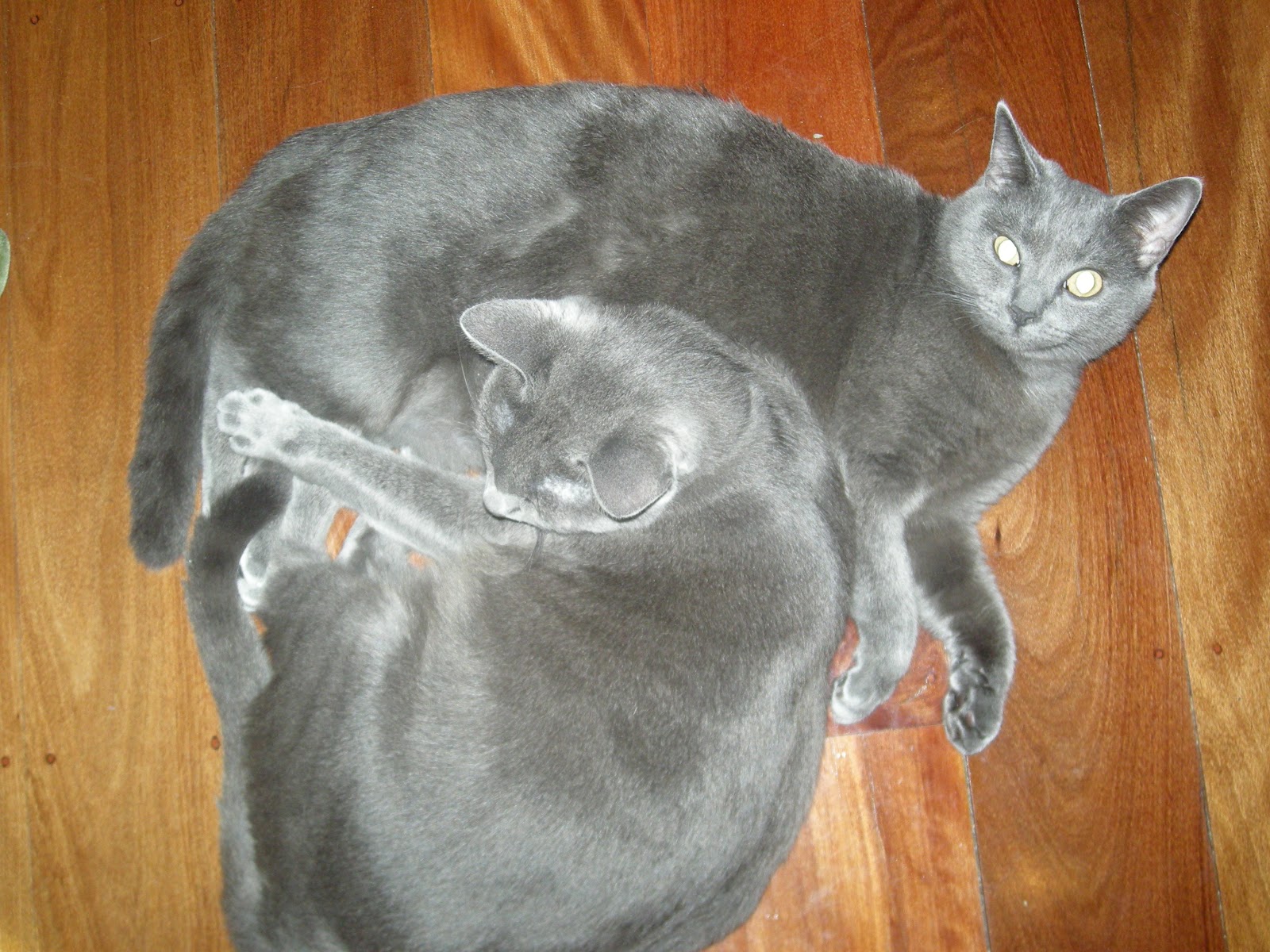
Cats of the Paulsen lab
Apparently, one of the requirements for joining the Paulsen
group is to be a cat parent. Here are the current cats in the Paulsen Research
Group.
 |
| Lyra and Chihiro |
 | |
| Dots and Rainy |
 |
| Jeena |
 |
| Suren |
 |
| Chocolate Rex |
 |
| Billy and Doris |
Sunday, 20 May 2012
What do Professors spend most of their time doing?
Yay I've managed to set up a poll.
My vote is for writing grants. I’m not sure people outside of academia realise just how much time is spent writing grants. Between 2010 and 2011, I’ve been involved in writing the following grants-
My vote is for writing grants. I’m not sure people outside of academia realise just how much time is spent writing grants. Between 2010 and 2011, I’ve been involved in writing the following grants-
2 Australian Research Council (ARC) Discovery Grants (both
funded)
9 National Health and Medical Research Council (NHMRC)
Grants (1 funded)
3 National Institutes of Health (USA) Grants (2 funded)
2 US Department of Agriculture Grants (1 funded)
1 ARC Centre of Excellence Grant (0 funded)
3 ARC LIEF equipment Grants (2 funded)
And it's not like these are short in length. For example, the ARC LIEF grant I wrote last year on Single Cell Genomics was 121 pages in length.
So what conclusions can we make from this catalogue of grant frenzy:
- I spend way too much time writing grants
- the ARC clearly love me, whereas I appear not to be very popular with the NHMRC.
- I’m averaging 10 grant applications a year, I seem to be
on track for the same number this year (4 NHMRC and 2 ARC LIEF grants submitted
this year)
- apparently we're not excellent, but we have had an ARC SuperScience proposal funded, so we must be super
- apparently we're not excellent, but we have had an ARC SuperScience proposal funded, so we must be super
Of course, since my staff seem to like getting paid, we don't really have much choice but a continuous frenzy of grant writing, unless I become independently wealthy or we find a rich benefector.
I'm sure there will be subsequent blog posts on the grant system, but my colleague Nick Coleman probably summed up many scientists feelings about the grant system in this article in the Sydney Morning Herald
Thursday, 10 May 2012
100-fold increase in North Pacific plastic waste
 When caught at the checkout without my own shopping bags last week I was utterly shocked at the amount of plastic bags that were used to pack my groceries. Some plastic bags were even packed with one single item?! While most of our plastic waste ends up in landfill, a significant amount of it gets washed out to sea where it is slowly degraded by sunlight and the action of waves.
A recent study published by Scripps researchers document a 100-fold increase in plastic waste in the middle of the North Pacific. Out here, where few people go, the ocean circulation patterns accumulate floating debris into massive garbage patches. The Scripps researchers found that the plastic particles, some of which are about the size of a fingernail, provided rafts for a marine invertebrate (Halobates) to lay its eggs.
When thinking about this problem the issue that comes to mind is plastic toxicity. This article is interesting because it discusses the wider ecosystem effects of all of those plastic objects making their way into our oceans: by creating additional solid surfaces and numerous new habitats for microbes and larger organisms this waste has the potential to change the the ecosystem structure in the open ocean. It makes me wonder whether we will soon be describing new species that have adapted to living in the shade of floating plastic particles?
Tuesday, 1 May 2012
Introducing the Team: The Biolog Omnilog
First stop on tours around the Paulsen lab is usually our
Biolog Omnilog instrument (a note from our sponsors- this instrument was purchased
by grant support from the Australian Research Council). This is the only
Omnilog machine in Australia, a fact that is mentioned in almost every grant we
write. The Biolog instrument gives us the capability of screening bacteria for
2000 functions simultaneously; e.g., testing their ability to grow on different
carbon compounds, their resistance to various drugs and toxic compounds, or
their ability to withstand various stresses. These tests are performed in a
96-well plate format where each well contains the specific compound we are
testing.
2000 cellular functions may sound like a lot, and it certainly beats making up 2000 separate agar plates to test each function. However, it is only testing a tiny fraction of the functional diversity that exists out there in the microbial world. Recently, we have been making our own “custom” Biolog plates by taking blank plates, adding in the Biolog proprietary buffers and dye, but then adding in the specific compounds we would like to test. For instance, we are interested in bacteria that grow on plant roots and provide beneficial effects for the plant, and we would like to know why particular bacteria prefer specific plant species. So we have been making our own Biolog plates that include specific compounds that the plant species secrete to find out what these bacteria like to eat.
We’re also happy to collaborate with other research groups; if you have a unique and interesting problem that might benefit from customized Biolog analyses, feel free to contact us.
 |
| it even matches the colour scheme of our lab! |
Subscribe to:
Posts (Atom)