Friday, 5 April 2013

It feels like its been 500 years

I've survived (barely) this season of grant writing. Our four National Health and Medical Research Council (NHMRC) grants were submitted a couple of weeks ago. Although I was ready for a vacation by that point, we also participated with an American team on an NIH Center for Translational Medicine application, which was submitted a few days ago. Now, all we have to do is wait six months and keep fingers, toes, eyes, etc crossed.

In the meantime, an interesting paper came out in the journal Nature, and got some press coverage at least in Australia, for instance this article in the Sydney Morning Herald, on the topic of scientific grant writing.To quote the SMH article:

"Australian scientists spent more than 500 years' worth of time preparing research funding applications for the country's largest grant scheme in 2012, according to a survey by Queensland researchers.
And as only one-fifth of proposals to the federal government's National Health and Medical Research Council were successful, scientists wasted the equivalent of four centuries diverted from their research."

At the moment it certainly feels like I've spent 500 years writing grant applications, and certainly I've done little else for the last three months. It does raise interesting questions- is this the best use of scientist's time and effort? Is it even the best way of distributing resources for research? One of my favourite stories on this topic is how in the 1990s Craig Venter and colleagues submitted a grant to sequence the first ever bacterial genome (Haemophilus influenzae) to the NIH. It scored the lowest possible score in the grant scoring scheme and received reviews saying that the grant was ridiculous and that the proposed work was impossible. They then went ahead and got private funding for this work, succeeded, published the genome in Science, and started the genomics revolution. An example of how truly innovative research is highly unlikely to be funded under current grant schemes, which tend to support incremental scientific advances.

Anyway, I'm going to stop here for the moment, but hope to revisit this topic in a subsequent blog post.


We're trying to avoid this situation


Monday, 11 March 2013

Oh oh oh .... caught in a bad project

Last week saw the submission of another grant (ARC Discovery Grant). Continuing on with the need for humour while surviving grant writing, this post highlights one of my favourite videos on YouTube. Bad Project is a parody of Lady Gaga's Bad Romance. I think many scientists can relate to the situation in this video. In fact, I like to say one my most important career skills was the ability to avoid "Research Projects from Hell".

Anyway this parody song not only has surprisingly good production values but has great lyrics, I always find myself singing-
Blot, Blot Western Baby, Figure One will be Amazing.
Blot, Blot Western Baby, Transfer- this exposure's hazy
Blot, Blot Western Baby, Got no bands this shit is crazy

I also love the box of eppendorf tubes labelled in Thai, reminds of a scientist I used to work with who labelled everything he worked on in Hebrew.


Friday, 1 March 2013

Microbial Lifestyles turns One!

It was exactly one year ago that I started this Microbial Lifestyles blog. With help from Martin Ostrowski and Sophie Mazard in my group, this last year has seen 63 blog posts. It's been fun, but also a struggle at times finding the time to write. It's been interesting which posts have generated alot of traffic and which remain unseen by everyone except my relatives and cats.

I do feel I've left alot undone that I had planned to do. For example, while I posted on how Science is portrayed in Games, this was supposed to be first post in a series on how science is portrayed in movies, tv, novels, etc. I seem to still be waiting on inspiration for those topics. Another example- I posted on my Reflections on five years at Macquarie University #1; we're still waiting on posts #2 and #3 in that series, and if I don't hurry up they will be "Reflections on six years".

Hopefully, we can see progress on these in year 2 of Microbial Lifestyles.


Happy Birthday!

Thursday, 28 February 2013

Happy 2nd Birthday JAMS

The second ever JAMS (Joint Academic Microbial Seminars) Annual Dinner was held yesterday at the Australiam Museum in Sydney. JAMS is normally a monthly seminar series at the museum, but once a year we have an annual dinner and invite 4-5 international/interstate guest speakers. We had extremely entertaining talks from all five speakers. The highlights for me were the talks from Phil Hugenholtz (UQ) who gave us a rapid but exciting trip through what we've learnt from the genomes of unculturable bacteria and Victoria Orphan from CalTech who looked at the function of bacterial communities from deep sea methane vents.

After the talks were dinner and drinks in the Dinosaur Room. The food was pretty good, one of the curiosities of my dinner was the unidentifiable vegetable on my plate that turned out to be a purple carrot. Who knew carrots could be purple? Apparently they are chockful of anthocyanins. I should probably eat alot more purple carrots!

Who knew carrots came in this colour
Many thanks again to JAMS organizer Federico Lauro for a great meeting!

Saturday, 23 February 2013

Life in the Dark

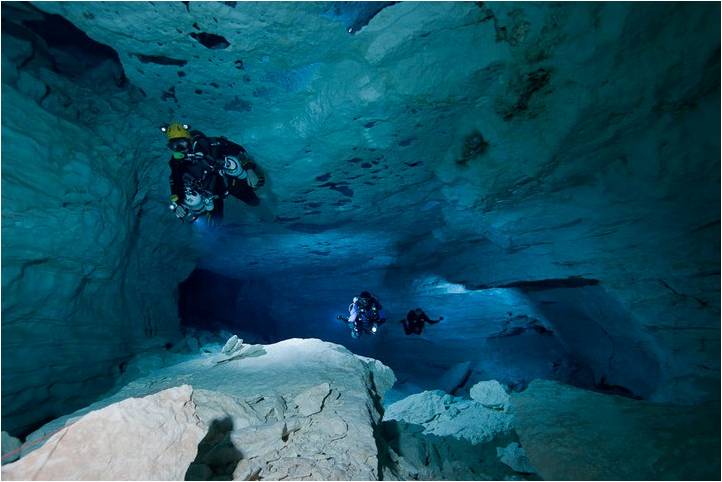
In caves deep beaneath the Nullarbor Plain (a desert region in Australia which is actually the world's single largest piece of limestone, more than a thousand miles across) live strange slimy microbial communities known as microbial "slime curtains". A very poetic name, I think. These organisms live in the dark in ancient salty water, with little or no input of fresh water or organic nutrients from the surface.

In tune with the the title of this blog, we were curious about the lifestyle of these bugs- how do they make a living in such a unusual setting? We've just published a paper entitled- "Life in the Dark: metagenomic evidence that a microbial slime community is driven by inorganic nitrogen metabolism" in the ISME Journal which tries to answer this question.


We received samples of the slime curtains from cave divers exploring Weebubbie Cave, and we broke those cells open, collected the DNA from the whole community, and then sequenced that DNA (this is known as metagenomic sequencing). Computational analyses of the millions of genes detected were used to see what we could learn about these bugs. What we found was that the microbial cave slimes consist of about 1000 different microorganisms, but one particular bug made up almost half of the total community. This dominant bug was a Thaumarcheota (yes I know that just rolls off the tongue) and almost certainly gets its energy by oxidizing ammonia found in the cave water. So, we think that ammonia oxidation is what enables this community to flourish within the caves.


Scanning electron micrograph of the microbial cave slimes, the long filaments we think are the Thaumarcheota

Cave divers (photo courtesy of Liz Rogers)

Microbial cave slimes in Weebubbie cave (photo courtesy of Peter Rogers)

Cave diver taking a sample of cave slimes for our lab to investigate (photo courtesy of Steve Trewavas)

Wednesday, 20 February 2013

I don't know what it means, but it is pretty

From the latest toy on LinkedIn, here's a network connection map of my LinkedIn connections. I should start off by saying I don't very actively look for people to connect to on LinkedIn, mostly I just respond to people's requests. In terms of analyzing my professional network connections, as far as I can tell orange= friends; green= Macquarie University colleagues; blue= TIGR/JCVI colleagues; purple= other academic colleagues, mostly bioinformaticians. The remaining colours are other academic colleagues or friends who live overseas.
So what conclusions can one draw from this? Um, aaah, errrr. I guess I am connected to distinct clusters of people, with no real connections between the clusters. Maybe a sign that I have lived in several different places in my life.
Still it's a fun toy to play with for 5 minutes and does make pretty diagrams.


Friday, 15 February 2013

More Grant Writing and Humour

Still struggling through grant writing season here. Martin is about to submit his Future Fellowship application, and I was up until 2.30 last night finishing my sections of a US Department of Agriculture Grant.
This segues into my next scientific humour post. I've long been a fan of PhD comics, which provides a surprisingly accurate and amusing view of scientific life. Recently, one of my PhD students gave me a copy of the PhD movie- I'm not quite sure what message he was trying to give me. Anyway, hopefully our grant writing frenzy will avoid this outcome:

I absolutely remember going through the shock phase before.