Monday, 14 October 2013

Congrats 2013 MQ iGEM team

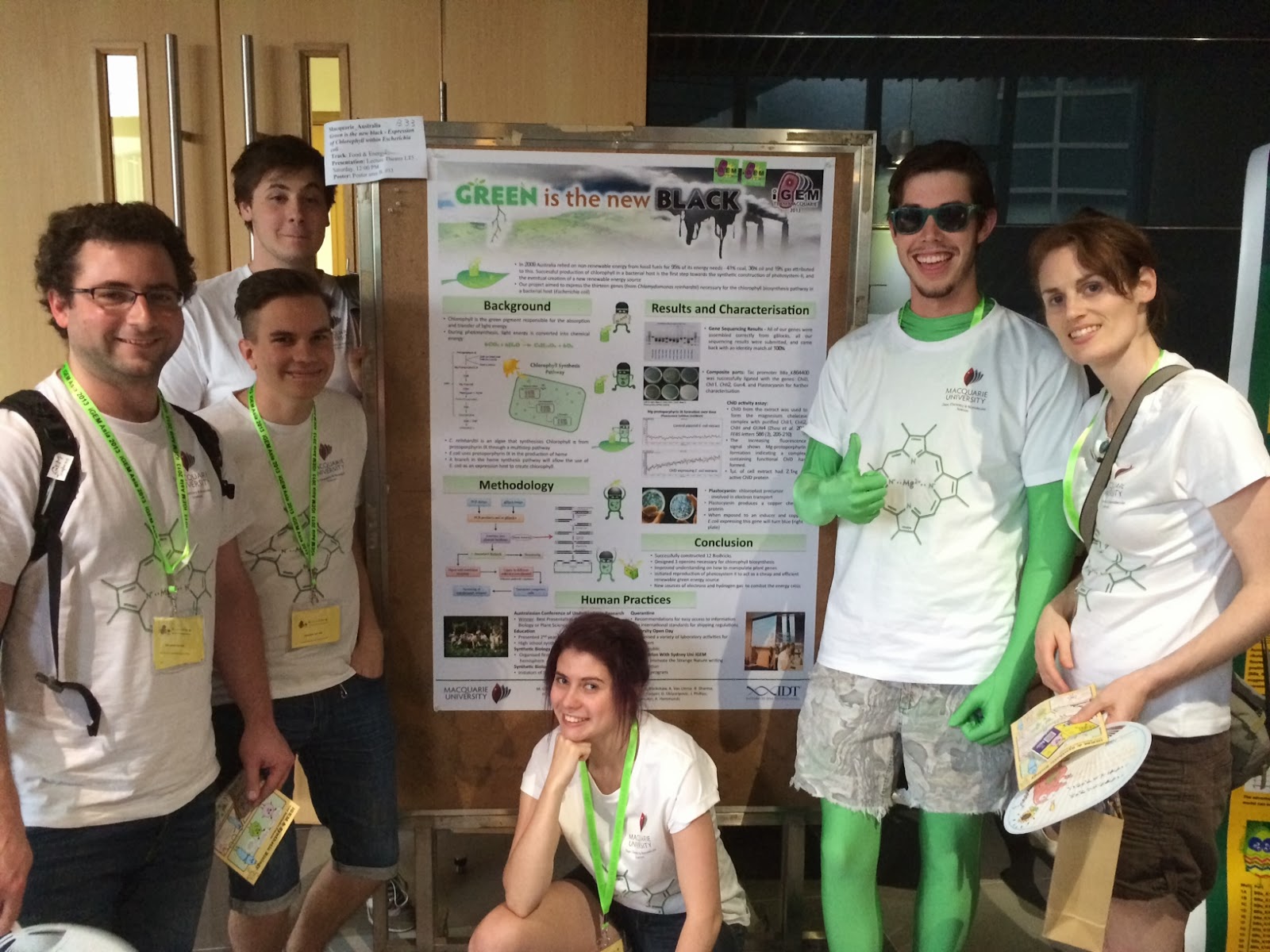
Congratulations to the 2013 Macquarie iGEM team for winning a Silver medal, as well as Special Awards for Best Poster and Best Mascot at the Asia Region Jamboree in Hong Kong! The  International Genetically Engineered Machine (iGEM) competition is a worldwide Synthetic Biology competition for teams of undergraduate students, where they try to build biological systems from standard, interchangeable parts and operate them in living cells. This year there were 204 University teams competing from all around the world.

This is the fourth year Macquarie has entered a team in the competition, and so far we've won three Silver medals and one Bronze medal. We've also been the top Australian team in the competition in each of the four years! Last year's team won a Silver medal for their work on engineeering a light sensitive genetic switch. This year's successful project was "Green is the new Black- expression of chlorophyll within Escherichia coli", where our team of 22 students successfully expressed many of the genes required for chlorophyll biosynthesis in E. coli, with the longer term goal of making a photosynthetic E.coli that could be used in bioenergy production. I'd like to say fantastic job to all of the team and their tireless advisors Dr Louise Brown and Associate Professor Rob Willows.

The Macquarie students also presented their work at the Second Australasian Conference of Undergraduate Research and won a $500 prize for Best Presentation in Plant Science or Molecular Biology.


The green and charismatic Chlorophyll Man, winner of best team mascot
The successful MQ iGEM team in Hong Kong with their award winning poster


Friday, 11 October 2013

BacPath

It's been a struggle recently to find time to blog. Last week I was away at BacPath, an Australian conference on the Molecular Analysis of Bacterial Pathogens. My cunning plan of live blogging from the conference was foiled by the fact there was practically no internet connections available at the meeting. I guess that's one of the downsides of having the meeting located on a sub-tropical island paradise (well Moreton Island anyway).

BacPath is one of my favourite scientific meeting, and in many ways reminds me of a Gordon Research Conference. Several features about BacPath I particularly like-
1. The relatively small size of the conference (150-180 people), which really gives you an pportunity to mix with and meet many of the delegates.
2. The fact that the meeting is always held at a relatively isolated location, so all of the delegates spend their entire time at the meeting, you end breakfast, lunch and dinner together, providing many opportunities to network, discuss science, arrange collaborations, etc.
3. The philosophy that junior scientists (PhDs students and postdocs) should give the vast majority of presentations rather than senior scientists.

In the interests of full disclosure I should say I was a member of the organizing committee for the 2011 BacPath meeting. BacPath is held once every two years, with each state taking a turn to host the meeting. In 2015 it will be Victoria's turn. This year it was in a lovely location, though sadly I think I set foot on the beach for about 10 minutes, although I should point out that I hand fed a dolphin in that 10 minutes.

There was a great set of talks at the meeting. Highlights for me included Cynthia Whitchurch's talk with beautiful videos of how exploding bacteria help bacterial biofilms develop. Also, Mike Jennings, the invited speaker for an Outstanding Contribution by an Australian Researcher, gave a great talk on phase variation of human pathogens. There were many other great talks at the meeting from Dena Lyras, Tim Stinnear and many others. Karl Hassan from my group gave a talk on a new type of drug efflux pump we've discovered.

The main problem with BacPath is at the end of it I'm always exhausted, as the talks start at 8.30 in the morning and the conference runs to 11 pm every night with poster sessions in the evening accompanied with alcoholic inducements for scientific discussion.

Moreton Island- its all made of sand


Friday, 27 September 2013

Quoting Donald Rumsfeld

Some of you may remember (perhaps not very fondly) Donald Rumsfeld, former US Secretary of Defense in the administration of George W. Bush. Surprisingly, the title of our latest publication actually quotes Donald Rumsfeld, whose famously said
"There are known knowns; there are things we know that we know.
There are known unknowns; that is to say, there are things that we now know we don't know.
But there are also unknown unknowns – there are things we do not know we don't know."

We've just published a paper in the journal PLoS One entitled Dead End Metabolites- Defining the Known Unknowns of the E. coli Metabolic Network. E. coli is the best model organism for studying bacteria, it is the single bacterium we know the most about after 50-60 years of study, and yet we still don't know what a quarter of it's genes do. In this paper, we use the E. coli metabolic network represented in the EcoCyc database, and try and work out what are the gaps in our knowledge about E. coli metabolism, or as Donald Rumsfeld would put it- what are the known unknowns of E. coli metabolism. Hopefully this list of known unknowns provides researchers targets for future study to enlarge our understanding of E. coli. As for the unknown unknowns, um well I guess we don't know yet.

E. coli is the one with the name tag

Tuesday, 10 September 2013

Transport Protein Workshop

I've gotten back from England, with the addition of about 4 kilos of weight from eating too many full English breakfasts. I'm going to need to need to fire up Dance Central 3 on the Xbox to work off the English sausages, bacon, black pudding, etc.

The last day in Leeds was a membrane transport workshop hosted  by Peter Henderson at the the Astbury Centre for Structural Molecular Biology, University of Leeds. Karl and I both gave talks on our groups work on characterizing multidrug efflux pumps, proteins that sit in the cell membrane, and pump out antibiotics and other drugs making the bacteria resistant.

The workshop dinner was held in the Royal Armoury in Leeds. After all of the tourists had gone home, we were able to stroll around the museum at our leisure, and see their collection of historical military and hunting artifacts, including a magnificent suit of Indian elephant armour. We then had dinner in an imitation English drawing room, whose walls were covered with leather bound books, stuffed animal heads, random weapons and other historic artifacts. A very memorable ending to an entertaining day of scientific presentations.

The Only Surviving Suit of Indian Elephant Armour in the World (dating from ~ 1600)
Here I am at dinner caught by a camera in mid-gesticulation. Also in the photo are Anne-Brit Kolsto and Ole Andreas Oksted from the University of Oslo.


Thursday, 29 August 2013

Musings on leg 1 of the IndigoV expedition and the meaning of science

As we near the start of the second leg of the IndigoV Indian Ocean expedition, it is time to reflect on what we have learnt during the first leg of the voyage.

- No matter how well prepared, something will go wrong
- When trying to lay low, try not to appear in newspapers
- Very fresh tuna is chewy but better than 2-minute noodles
- The Indigo V is relatively water-tight even during very big storms (luckily)
- If we say there will be restaurant quality food on board, let's not kid ourselves, the 2-minute noodles will do very well...
- Electrical equipment and seawater do not mix (actually, any equipment and seawater does not mix)
- Clothing drenched in seawater never drys properly
- There are a lot of (very) big ships sailing the Indian Ocean
- Never let a certain Martin Ostrowski at the helm when there are big waves and you want to sleep below deck. (I heard he likes to surf...)
- Whales are amazing and always appear when all the camera's batteries are flat

Jokes apart, the whole experiment of the Indigo V expedition was a unique experience, showing it is possible to run scientific expeditions with less expensive equipment, and in a more cash efficient way. Indeed, the whole expedition is running at the price of a single day from a standard research vessel.
"Accessible" projects such as the IndigoV Indian Ocean expedition are important on scientific grounds, but also vital to engage interest within the scientific community, as well as the general public and media.

This opens the wide and exciting world of crowd funding of science. We might never be as successful as the guys building a space telescope, but the general idea is the same in that research should not be conducted in a small dark laboratory, behind closed doors. Scientist should be engaging with wider community and be approachable even if it takes time out of staring at computers or petri dishes.

The main aim of science is to make people think, feel included and want to participate. I'm not particularly proud of myself when I have blank stares from people when I am trying to explain what I do!

So onward and upward (or north-east-ward to be more precise!) with the IndigoV Indian Ocean expedition. Good luck to the brave sailors.

To be continued....


Tuesday, 13 August 2013

My cats have probably forgotten me

After a week in Canberra, I was home for a day or so, and then had to fly off to England. I've just arrived in Leeds after 36 hours of travel time, where I am about to collapse into a coma. I'm here to visit with my collaborators and to give a talk at a membrane transporter workshop. My talk has one of my sillier titles to date- "Channeling David Attenborough- Studying Bacterial Drug Efflux Pumps in their Native Habitat".


The Met Hotel, my room is somewhere on the 3rd floor

Catching up on posts from last week

My birthday at the NHMRC panel. The chairperson's wife baked me a birthday cake! It came complete with birthday candles thanks to the NHMRC!


Photo thanks to Mark Schembri